
2025 Taxes
Top Things to Know
Trump promises ‘largest tax refund season of all time.’ What you can expect.
As the 2026 tax season approaches, President Donald Trump is promising bigger tax refunds due to 2025 changes enacted via his “big beautiful bill.”
“Next spring is projected to be the largest tax refund season of all time,” Trump said Wednesday in a prime-time address from the White House.
But your 2026 refund will depend on your 2025 taxes paid and which new provisions will affect your situation, experts say.
Typically, you get a refund when you overpay taxes throughout the year via paycheck withholdings or estimated tax payments. By comparison, there’s a bill when you don’t pay enough.
Trump’s address comes amid the president’s falling approval ratings on inflation and the cost of living, according to the CNBC All-America Economic Survey, which polled 1,000 U.S. adults in early December.
Some 66% of those surveyed in December disapproved of Trump’s handling of inflation and the cost of living, compared to 62% in October, the poll found.
As many feel the pinch of higher prices during the holiday season, here’s what to know about tax refunds in 2026.
Many will see ‘larger refunds’ in 2026
When filing 2025 tax returns in 2026, “many will see larger refunds than in recent years,” Erica York, vice president of federal tax policy with the Tax Foundation’s Center for Federal Tax Policy, wrote in an analysis on Wednesday.
Enacted in July, Trump’s “big beautiful bill” included several retroactive tax changes for 2025, including a bigger standard deduction; more generous maximum child tax credit; a higher limit for the state and local tax deduction; a $6,000 tax break for seniors; and deductions for auto loan interest, tip income and overtime pay.
These seven provisions reduced individual income taxes by $144 billion in 2025, according to Tax Foundation estimates. However, the IRS did not adjust withholding tables, which tell employers how much to take from worker paychecks.
“Instead of gradually receiving the benefit of the tax cuts through higher take-home pay during the year, most taxpayers will receive it all at once when they file their returns,” York wrote.
Who could see a bigger refund
Your 2026 tax refund could depend on which provisions affect your individual situation, experts say.
The higher standard deduction, bigger child tax credit and senior tax break will have an impact on many taxpayers, whereas other provisions, such as deductions on tip and overtime income, affect smaller groups of filers.
For many, Trump’s legislation was an extension of the tax breaks enacted in 2017, Alex Muresianu, a senior policy analyst at the Tax Foundation, previously told CNBC.
“The basic structure of it is going to be very much the same tax code that you’ve been used to for the past eight years,” he said.
A note released by Piper Sandler on Oct. 31 also predicted “an exceptionally large refund season,” with middle- and upper-income taxpayers likely to benefit the most.
As of Oct. 17, the average refund for individual returns was $3,052 during the 2025 filing season, up slightly from $3,004 in 2024, according to the latest IRS data.
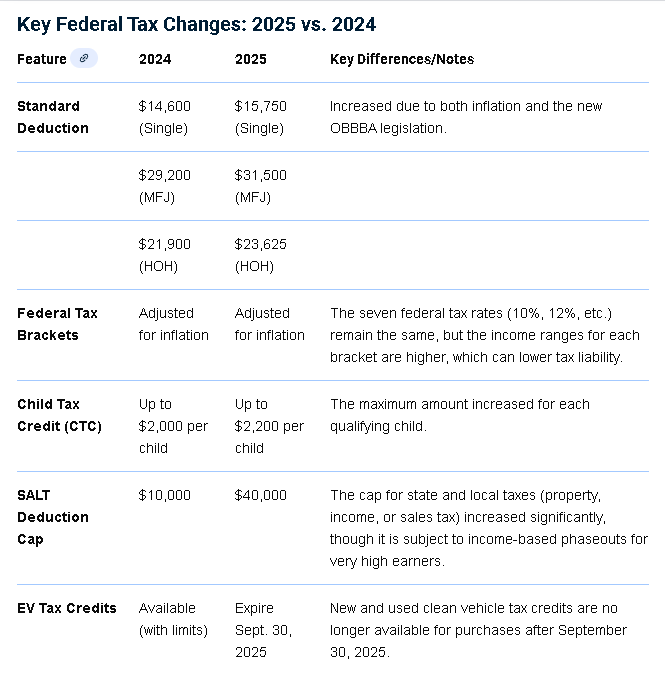
For the 2025 tax year, key changes compared to 2024 include higher standard deductions and tax brackets (due to inflation and new legislation), new income-limited deductions for tips, overtime, and senior citizens, and a higher cap on the State and Local Tax (SALT) deduction.
These changes stem primarily from the passage of the "One Big Beautiful Bill Act" (OBBBA) in July 2025, which made many provisions from the 2017 Tax Cuts and Jobs Act permanent and introduced new, temporary tax breaks.
New Deductions for 2025
The OBBBA introduced several new, temporary deductions (effective 2025 through 2028) that can be taken even if you claim the standard deduction, though they have income limitations:
Seniors: An additional $6,000 deduction for those born before January 2, 1961, or $12,000 if both spouses in a joint-filing couple qualify.
Tips: Eligible tipped workers can deduct up to $25,000 of "qualified" tip income.
Overtime Pay: A deduction for a portion of "qualified" overtime pay, capped at $12,500 ($25,000 for joint filers).
Car Loan Interest: A deduction up to $10,000 for interest paid on a loan for a new vehicle where the final production stage was completed in the United States.
"Trump Accounts" for Babies: A new program where the federal government deposits $1,000 into an investment account for eligible babies born between January 1, 2025, and December 31, 2028.