
TO BETTER UNDERSTAND THE FICA
(SOCIAL SECURITY & MEDICARE)
REFUND PROCESS
WATCH THE GUIDE TO FICA VIDEO BELOW
OUR FIRMS DEADLINE FOR FICA REFUND SUBMISSIONS
FOR YEAR 2022 IS DECEMBER 13TH, 2025!
NO ACCEPTIONS WILL BE MADE!
IF YOU MISS THIS DEADLINE THERE IS A SLIM CHANCE THAT YOU WILL BE ABLE
TO PROPERLY CLAIM YOUR FICA REFUND DUE TO ALL THE LEGAL
REQUIREMENTS THAT NEED TO BE MET PRIOR TO FILING AN ABATEMENT.
KNOWING THIS, IF IT IS PAST THIS DATE, OUR FIRM WILL NOT TAKE ON
YOUR CASE FOR YEAR 2022. UNFORTUNATELY, WE BELIEVE THAT THOSE WITHHOLDINGS
WILL MOST LIKELY NOT BE RETAINABLE DUE TO THE 3 YEARS TO CLAIM RULE.

Alien Liability for Social Security and Medicare Taxes of Foreign Teachers, Foreign Researchers, and Other Foreign Professionals
In general aliens performing services in the United States (U.S.) as employees are liable for U.S. Social Security and Medicare taxes.
However, certain classes of alien employees are exempt from U.S. Social Security and Medicare taxes.
Resident aliens, in general, have the same liability for Social Security/Medicare Taxes as U.S. Citizens.
Nonresident aliens, in general, are also liable for Social Security/Medicare Taxes on wages paid to them for services performed by them in the United States, with certain exceptions based on their nonimmigrant status.
Non-Resident Alien Teachers, Researchers and Other Professionals under a J-1 or Q-1 Visa Status
Foreign scholars, professors, teachers, trainees, researchers, physicians, au pairs, summer camp workers, and other non-student aliens temporarily present in the United States in J-1, or Q-1 nonimmigrant status for less than 2 calendar years are generally nonresident aliens under residency rules of IRC section 7701(b). There are other special circumstances that may allow for exemption periods that extend past the 2 year period when non-resident income tax exemptions are claimed under a treaty exemption.
These nonresident teachers, researchers and scholars are exempt from Social Security Tax and Medicare Tax on wages paid to them for services performed within the United States.
To qualify for the exemption the services performed must be allowed by United States Citizenship and Immigration Services (USCIS) for these nonimmigrant statuses, and such services are performed to carry out the purposes for which such visas were issued to them.
Exempt Employment includes:
- Employment as a professor, teacher or researcher.
- Employment as a physician, au pair, summer camp worker, or any other non-student category of exchange visitor.
Limitations on exemption:
- The exemption does not apply to spouses and children in J-2 nonimmigrant status.
- The exemption does not apply to employment not allowed by USCIS or to employment not closely connected to the purpose for which the visa was issued.
- The exemption does not apply to J-1, or Q-1 nonimmigrants who change to an immigration status which is not exempt or to a special protected status.
- The exemption does not apply to J-1, or Q-1 nonimmigrants who become resident aliens.
Family Members of Foreign Teachers, Foreign Researchers,
and Other Foreign Professionals
The IRS has issued regulations which clearly stipulate that the spouses and dependents of alien scholars, trainees, teachers, or researchers temporarily present in the United States in J-2 status are NOT exempt from Social Security and Medicare taxes, and are fully liable for Social Security/Medicare taxes on any wages they earn in the United States because such aliens have not entered the United States for the primary purpose of engaging in training, teaching, or research.
However, if the alien in J-2 status is employed doing a type of work which is exempt from Social Security and Medicare tax under the code, then the exemption still applies.
For example, the wages paid to a J-2 teacher employed by a state university might be exempt from Social Security and Medicare tax if the state has not elected Social Security and Medicare coverage for state employees under Section 218 of the Social Security Act.

Change in Status of Foreign Teachers, Foreign Researchers,
and Other Foreign Professionals
Alien scholars, trainees, teachers, or researchers in J-1 or Q-1 status who change to a nonimmigrant status other than J-1 or Q-1 will become liable for Social Security/Medicare taxes in most cases on the very day of the change of status.
Teachers, trainees, and researchers in H-1b status, and alien nurses in H-1a or H-1c status, are liable for Social Security/Medicare taxes from the very first day of U.S. employment, regardless of whether they are nonresident or resident aliens, and regardless of whether their wages may or may not be exempt from federal income taxes under an income tax treaty.
The acception being that unless the provisions of a Totalization Agreement relieve such aliens from liability for U.S. Social Security/Medicare taxes exists. The United States has entered into 26 Totalization Agreements, but not with the Philippines.

Request Refund of Social Security or Medicare Taxes Withheld in Error
If social security or Medicare taxes were withheld in error from pay and based on your filing status as a J1 Non-Resident and you are not subject to these taxes, contact the employer who withheld the taxes for a refund.
99.9% of the time your employer will not do anything to try to get you the money back. This is because they have already submitted it and don't know what to do or just don't want to deal with it. Most employers, they will tell you that its on you to try and get it refunded to you. So most J1 teachers are simply out of luck, and on their own to get it back on your own.
This is where we come in. If you are unable to get a full refund of the withheld amounts from your employer, you will have to file a claim for refund with the Internal Revenue Service, Social Security Administration and also with Medicare.
Processing these claims and requests for refund
Starting in OCTOBER 2025, We will be processing these claims and requests for clients who meet the qualifying criteria.
If you have consistently filed your income taxes as as a Non-Resident foreign worker using the 1040NR and also filed with your State taxes as a Non-Resident, the process is more likely to go pretty smooth.
The most optimum time to file for your FICA (Social Security and Medicare) refund is when you are in the latter part of your 3rd year and beginning of your 4th year.
This is so you make a single request and only pay our processing fee one time. If you want to request the refund each year you can do that as well; it just means you will pay for our services each time we process a request.
To get started, we will have you sign a legal document preparation "retainer agreement". We will also have you sign a specific power of Attorney allowing us to talk to and discuss this legal matter on your behalf specifically with the IRS, Social Security Administration and any other governing connected party such as your current or prior employers as needed.
WHAT DOES AN EMPLOYER NEED TO DO
IF THEY ELECT TO REFUND FICA TO AN EMPLOYEE
Claiming a Refund
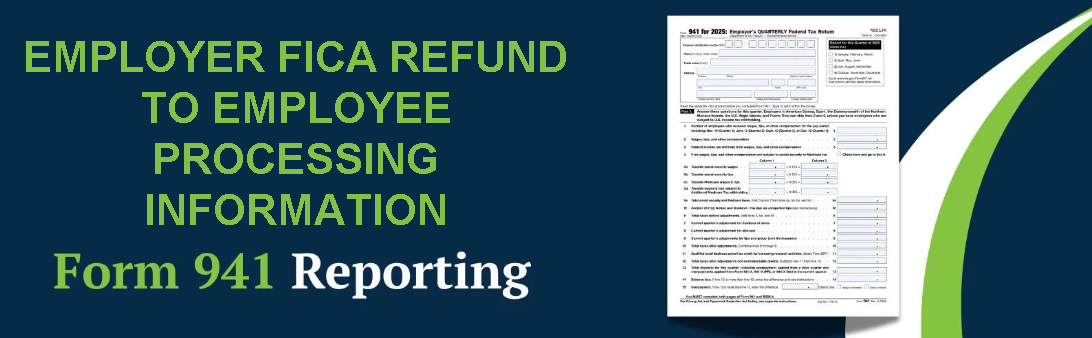
Generally, an employer claims a refund of FICA taxes on Form 941-X, Adjusted Employer's QUARTERLY Federal Tax Return or Claim for Refund. The employer must file a separate Form 941-X for each period it claims a refund. Generally, an employer must include the employee portion of FICA tax in its claim for refund on Form 941-X.
The IRS cannot refund the employee share of the overpaid FICA taxes unless one of the following conditions is met:
1. The employer has first repaid or reimbursed its employee or
2. The employer has secured the employee's consent to the allowance of the refund claim.
For refund claims for employee tax over collected in prior years:
Treasury Regulation, Section 31.6402(a)-2(a)(1)(ii).
2a. The employer must also certify that it has obtained the employee’s written statement confirming that the employee has not made any previous claims (or the claims were rejected) and will not make any future claims for refund of the amount of the overcollection. Treasury Regulation, Section 31.6402(a)-2(a)(2).
Revenue procedure 2017-18, 2017-14 IRB 1, describes the basic requirements for requesting employee consent.
If the IRS grants the refund, the IRS will refund the taxes (including any applicable interest paid under Section 6611) to the employer. The employer must then give each employee his or her share of the refund.
2b. If an employee does not consent to the employer’s claim for refund on Form 941-X on his or her behalf, the employer may only get a refund of the employer portion of FICA tax.
However, an employee may separately file a claim for refund of his or her portion of FICA tax "Claim for Refund and Request for Abatement:.
The Form instructions contain requirements an employee must satisfy, including attaching a statement to the Forms that indicates:
1. The amount, if any, the employer has repaid or reimbursed the employee for excess taxes withheld, and
2. The amount, if any, of credit or refund claimed by the employer or authorized by the employee to be claimed by the employer.
Similar to the Form 941-X, an employee must file for each taxable period for which a refund is requested.
However, an extension of the period of limitation by the employer does not extend the period of limitation for an employee to claim a refund.
While an employee also can utilize the agreement process from Section 6501(c)(4) of the Code to extend a period of limitation for years for which the applicable period of limitations has not yet expired, alternatively the employee can protect its interests by filing a refund claim for each such period in accordance with the instructions to Forms.
Social Security Benefits
Whether or not a refund is requested by the employer or the employee may not affect the allocation of wage credits for Social Security purposes, however. Collection of FICA taxes and wage credits are related, but separate questions.
The IRS administers FICA taxes while the SSA records wages reported. See 42 U.S.C. Section 405(c)(2)(A).
Wages subject to FICA are generally treated the same as wages recorded and used by SSA to determine entitlement to benefits, but not always. See, for example, U.S. v. Cleveland Indians Baseball Company, 532 U.S. 200 (2001) (differing on what time period should be used for taxation purposes versus wage crediting purposes).
If wages are exempt from eligible employment under 42 U.S.C. Section 410(a)(4) and should not be credited, then SSA cannot give credit for the wages under the law.
The SSA relies on taxpayers filing correct Forms W-2c so that it has sufficient information to correct wrongly reported wages.
If an employer does not file the required forms, SSA would still remove credit for wages if it became aware of the wrongly attributed wages.
Whether a FICA refund was requested and allowed would not affect the SSA’s decision to remove wrongly attributed wages from its records.
Filing Form W-2c
An employer is required to properly report wages.
Section 6051 requires every employer to file with the SSA and furnish to its employees a Form W-2, Wage and Tax Statement, showing the amount of wages and taxes withheld.
Occasionally, there are errors in the reporting of wages.
Employers use Form W-2c, Corrected Wage & Tax Statement, to correct a mistake on a previously issued Form W-2.
Law requires employers to provide the statement to the employee. Treasury Regulation, Section 31.6051-1(d)(1).
Employers are required to file the Form W-2c with the SSA. Treasury Regulation, Sections 31.6051-2, 31.6071(a)-1.
The SSA will correct errors, but must first have evidence of the error.
The SSA frequently uses the Form W-2c to identify errors and make necessary corrections. However, other evidence may alert the SSA to errors in wage reporting.
Wage record corrections are generally subject to a time limitation (defined at 42 U.S.C. Section 405(c)(1)(B) as 3 years, 3 months, and 15 days after the wage year), but there are exceptions to this rule. See 42 U.S.C. Section 405(c)(5)(allowing changes to wage records after the expiration of the time limitation).
For example, if a Form W-2c is filed outside of the statute of limitations, 42 U.S.C. Section 405(c)(5)(F) permits the SSA to change its records to conform to the W-2c.
Other exceptions may also apply and permit the SSA to correct wage records outside of the prescribed statute of limitations.
Under Sections 6721 and 6722, an employer may be penalized for reporting incorrect information on a Form W-2.
Filing a Form W-2c will, in certain circumstances, result in a reduced penalty or penalties for the employer.