
General Notice:
The IRS says to allow a minimum of 21-day processing window which begins after the IRS officially accepts your return, not when you submit it to us to prepare your return. Some returns may take much longer than 21 days depending on IRS backlogs. We have no control over how long it may take. We do not follow up or contact the IRS or State tax agency to track your tax return processing. Per the contract for services, Once we file your return our services are completed. You can go to the IRS official website and search "where is my refund" and follow the instructions or contact them directly.
Where's My Refund?
The IRS expanded the refund timelines for 2026.
Which unfortunately means that most of us will have longer wait times
to get our refunds. Tax Preparers have no control over the IRS
or State taxation agencies and their processing times.
See the 2026 IRS "Direct Deposit and Paper Check" Refund Calendar Shown Below.
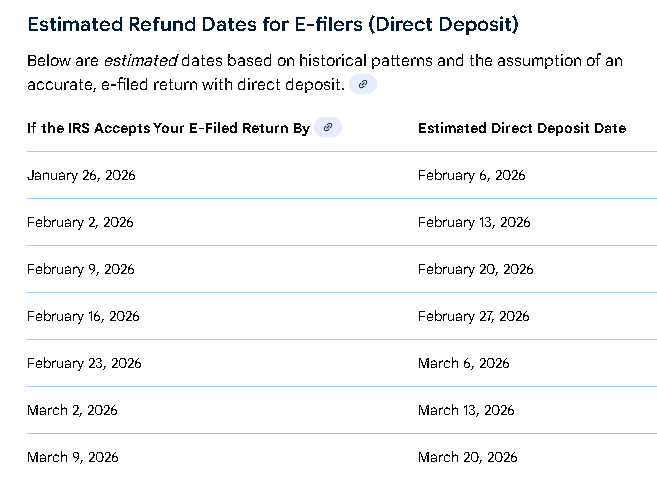
General 2026 Refund Timeline Guidelines
E-file opening date: The IRS is expected to begin accepting e-filed returns in late January 2026, around January 26.
Processing time: The 21-day processing window begins after the IRS officially accepts your return, not when you submit it to a tax software provider.
Filing method: E-filing with direct deposit is the fastest method. Paper returns can take 6 to 8 weeks or longer to process.
Identity verification/errors: Incomplete returns, errors, or the need for identity verification can significantly delay your refund.
Delays for EITC and ACTC Filers
By federal law (the PATH Act), the IRS must hold refunds for tax returns claiming the Earned Income Tax Credit (EITC) or Additional Child Tax Credit (ACTC) until at least mid-February. For the 2026 season, the first wave of these refunds with direct deposit is generally expected by early March.
Get Your Refund Faster: By Having The IRS "Direct Deposit" Your Refund
Combining direct deposit with electronic filing is the fastest way to receive your refund. There’s no chance of it going uncashed, getting lost, stolen, or destroyed. The IRS issues more than seven out of ten Federal Tax refunds in less than 21 days.
Direct deposit must only be made to accounts bearing the taxpayer’s name.
What you need to "Check Your Refund"
* Your Social Security (SSN) or individual taxpayer ID number (ITIN)
* Your filing status
* The exact refund amount on your return
Check your refund
Prefer a mobile app? You can also check your refund with IRS2Go.
Find your tax information in your online account or get a copy (transcript) of your tax records.
To check an amended return, visit Where's My Amended Return?
How it works
Where's My Refund shows your refund status:
Return Received – IRS received your return and are processing it.
Refund Approved – IRS approved your refund and are preparing to issue it by the date shown.
Refund Sent – IRS sent the refund to your bank or to you in the mail. It may take 5 days for it to show in your bank account or several weeks for your check to arrive in the mail.
Before you file a second tax return
Filing the same tax return again typically won't speed up your refund and could cause delays.
You should resubmit your tax return, electronically if possible, only if all of these apply:
You are due a refund
You filed on paper more than 6 months ago
Where’s My Refund doesn’t show that the IRS received your return.
When to call the IRS
Call the IRS about your refund status only if Where's My Refund recommends you contact THEM.
If your refund is delayed
Your refund may be delayed if your return needs corrections or extra review.
If the IRS need more information to process your return, THEY will send you a notice.
The latest date, by law, you can claim a credit or federal income tax refund for a specific tax year is generally the later of these 2 dates:
- 3 years from the date you filed your federal income tax return, or
- 2 years from the date you paid the tax.
This time period is called the Refund Statute Expiration Date (RSED).
If you filed your return before its due date, the IRS considers it filed on the due date. If you had income tax withheld or paid estimated tax during the year, we consider those payments to have been made on the return due date.
How much credit or refund you can receive
The amount of credit or refund you can receive depends on when you file your claim.
You file a claim within 3 years from when you file your return
Your credit or refund is limited to the amount you paid during the 3 years before you filed the claim, plus any extensions of time you had to file your return.
You file a claim after 2 years from when you paid the tax
Your credit or refund is limited to the amount you paid within the 2 years right before you filed your claim.
When you didn't file a claim within the 3-year or 2-year expiration dates
You can't get a credit or refund if you don't file the claim within 3 years of filing your original return, or 2 years after paying the tax, whichever is later, unless you meet an exception that allows you more time to file a claim.
Exceptions to the 3-year/2-year expiration dates
You may have more time to file a claim for credit or refund than the 3-year/2-year rules if you:
- Agree with the IRS in writing to extend the time limit to assess tax: The time limit is specified in your agreement, plus 6 months, to claim a credit or refund. There may be additional limits on the amount of credit or refund you can claim based on any limitations on the IRS's ability to assess tax, as shown in the written terms of your signed agreement.
- Are affected by a Presidentially declared disaster: You may have up to 1 more year to claim a credit or refund.
- Serve in a designated combat zone or contingency operation: You may have additional time to file a claim for a credit or refund, but you must meet certain requirements to qualify. See Armed Forces' Tax Guide, Publication 3 and combat zones.
- File because of a bad debt deduction or a worthless security loss: You have 7 years from the return due date for that year to file the claim. See Tax Topic 453 Bad Debt Deduction.
How to file a claim for a credit or refund
Claim a credit or refund for income taxes on your:
- Original return (for example, Form 1040, U.S. Individual Income Tax Return PDF)
- Amended return (for example, Form 1040-X, Amended U.S. Individual Income Tax Return)
If filing an amended return, send it to the IRS Service Center where you filed your original return. You can file Form 1040-X electronically with tax return filing software to amend Forms 1040, 1040-SR, 1040NR, or 1040-SS for the current or 2 prior tax years and up to 3 amended returns per tax year. See if your preferred tax software provider is an IRS Free File provider.